20 Study Tips for College Students That Actually Changed My Grades
High school studying and college studying are two entirely different sports. In high school, teachers hold your hand, remind you of deadlines every day, and give you study guides that mirror the test exactly.
In college, a professor will hand you a 40-page syllabus on day one, deliver a lecture that covers 3 chapters in 50 minutes, and casually mention that the midterm is worth 40% of your grade. Nobody checks if you do the readings. It is entirely on you.
If you are struggling to adapt to the university workload, or you are deeply tired of putting in maximum effort for average grades, this list is for you. These 20 tips aren't generic "make sure you eat breakfast" fluff. They are battle-tested, highly effective strategies that have fundamentally changed how I perform academically.
Here are the 20 study tips that actually work in college.
Mastering the Material
1. Go to Office Hours (Even if you don't have questions). Professors grade your papers. If a professor knows your face, sees you trying, and knows your name, they are infinitely more likely to bump your 89.4% up to an A-. Office hours are relationship-building, not just tutoring.
2. Stop highlighting everything. If the whole page is yellow, nothing stands out. Only highlight the core claim of a paragraph and the specific data point that supports it.
3. Use the Syllabus as a Study Guide. Most professors base their exams on the specific learning objectives listed in the syllabus. Look at the weekly topics and turn them into questions. If week 4 is "The Causes of the French Revolution," your primary study goal is to explain exactly that.
4. The 24-Hour Review Rule. Read over your lecture notes within 24 hours of taking them. This simple 10-minute pass stops the "forgetting curve" in its tracks and saves you hours of re-learning right before the midterm.
5. Teach the Wall. The best way to see if you know the material is to teach it out loud. Stand up in an empty room and lecture to the wall. If you stammer, pause, or have to check your notes, you've found a weak spot you need to study more.
Time & Task Management
6. The "Two-Minute Rule." If an assignment, email reply, or task takes less than two minutes to complete, do it immediately. Do not put it on a to-do list. This prevents the admin pile-up that plagues college students.
7. Treat college like a 9-to-5 job. If you have a 3-hour gap between classes on Tuesday, do not go back to your dorm. Go straight to the library and study. If you treat 9 AM to 5 PM as strictly work hours, you will actually have your evenings and weekends completely free.
8. Batch process your reading. Don't read 10 pages for Bio, switch to 5 pages for English, and then go back to Bio. Context switching destroys productivity. Do all the readings for one class in one sitting.
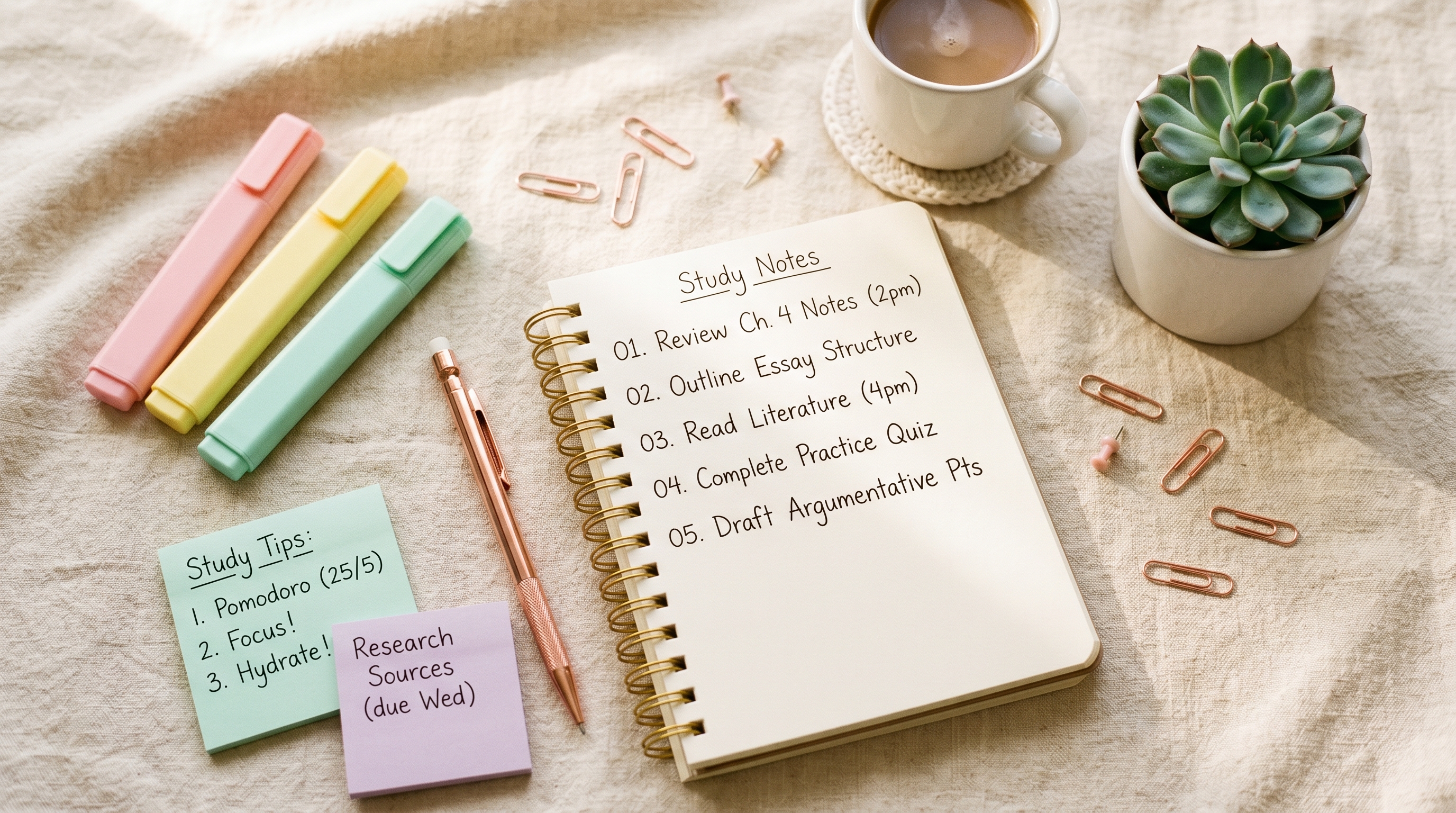
9. Use the "Pomodoro" method for readings. Reading tedious textbooks leads to sleep. Set a timer for 25 minutes and race yourself to finish a set number of pages before it rings. This gamifies the reading and keeps you awake.
10. Plan your week on Sunday night. Before the chaos of Monday begins, sit down with your planner. Look at every assignment due this week and block out the literal hours on your calendar when you will work on them.
The Exam Strategy
11. Make the "Cheat Sheet" early. Even if the test is closed-book, create a one-page, highly dense "cheat sheet" of exactly what you would bring into the exam if you were allowed to. Condensing the material forces you to prioritize what is actually important.
12. Study the mistakes, not just the successes. When taking practice exams, reviewing why you got an answer wrong is three times more valuable than celebrating the ones you got right.
13. Sleep > Cramming. An extra hour of sleep will improve your cognitive processing, recall, and critical thinking significantly more than an extra hour of frantic reading at 3 AM.
14. Do the hardest task first. When you sit down to study, attack the subject you hate the most or the hardest problem set first. Your willpower is highest at the beginning of the session. Get it out of the way.
15. Use the "Brain Dump" at the start of the test. When the professor says "you may begin," flip the test over to the blank back page and immediately dump every formula, abbreviation, and date you are scared of forgetting. Now you have a reference sheet.
Systemizing the Lifestyle
16. Never study on your bed. Your brain associates your bed with sleep. If you study there, you will get tired, and eventually, you will start associating your bed with academic stress, leading to insomnia. Your desk is for studying; your bed is for sleeping.
17. Build a "frictionless" setup. Keep your backpack fully packed by the door. Have your laptops charged. Have your water bottle full. The harder it is to start studying, the more likely you are to procrastinate.
18. Instrumental music only. Listening to songs with lyrics actively engages the language-processing center of your brain, making reading comprehension nearly impossible. Stick to Lo-Fi, classical, or movie scores.
19. Audit your friend group. You are the average of the five people you spend the most time with. If your friends skip class and mock studying, you will too. Find people who care about their future. Study with them.
20. Give yourself grace. You will fail a test. You will miss an assignment. You will have a terrible week. College is incredibly hard, and you are learning how to be a fully independent adult while doing it. When you fail, analyze it, adjust your strategy, and keep moving forward. You've got this.