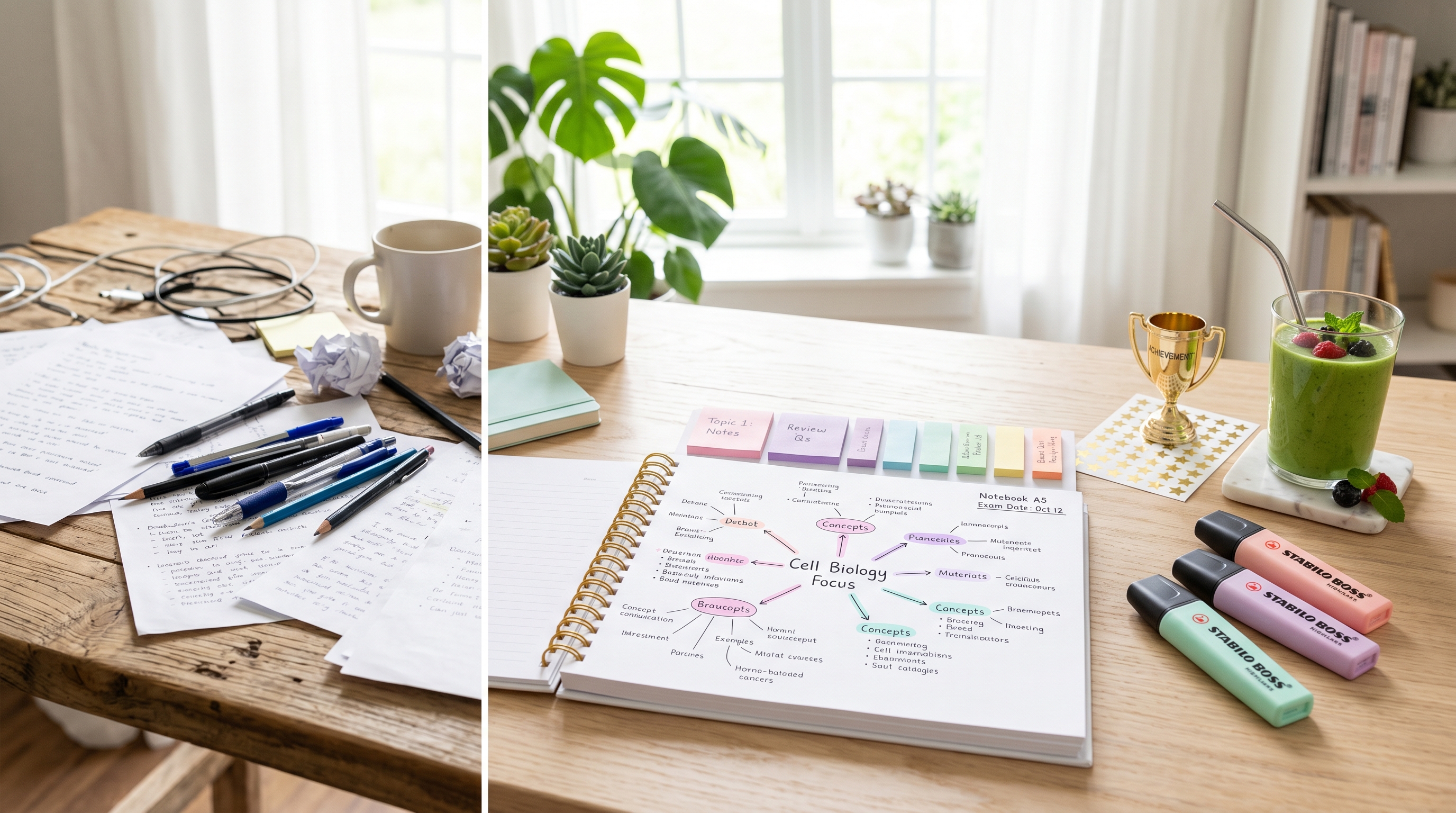
How to Study Effectively: The Complete Science-Backed Guide for Students
You sit down at your desk. You open your textbook. You highlight three pages of text. You read your notes over and over for three hours. And yet, when you sit down to take the test two days later, your mind goes completely blank.
Sound familiar?
The truth is, most students are never actually taught how to study. We are told to "study hard," but nobody explains the neurological mechanisms of how the human brain actually encodes and retrieves information. As a result, we fall back on "passive studying" techniques—like re-reading and highlighting—which feel productive but yield disastrous results during exams.
If you are tired of putting in maximum effort for minimum return, it's time to change your strategy. In this ultimate guide, we are breaking down the absolute most effective, science-backed study techniques. By implementing these strategies, you will cut your study time in half while doubling your retention.
Let's learn how to study smarter, not just harder.
The Science of Learning: Active vs. Passive Studying
Before we look at the specific techniques, you need to understand the fundamental law of learning: Memory is the residue of thought.
If passing your eyes over a page doesn't require hard mental effort, your brain will not remember it.
- Passive Studying: Highlighting, reading a textbook multiple times, listening to a lecture without taking notes, or re-copying notes verbatim. It feels easy.
- Active Studying: Retrieving information from your brain without looking at the answer. It feels difficult, frustrating, and exhausting.
If your studying doesn't feel challenging, you aren't actually learning. The key to effective studying is entirely about making the process active.
1. Active Recall: The Undisputed King of Studying
Active recall is the process of testing yourself on material before you are officially tested on it. When you force your brain to retrieve a piece of information from memory, you strengthen the neural pathway connecting to that memory.
How to Implement Active Recall:
- Flashcards (Anki or Quizlet): Put the concept on the front, and the definition on the back. Force yourself to say the answer out loud before flipping the card.
- The "Brain Dump" Method: Read a chapter of your textbook. Close the book. Take a blank sheet of paper and write down everything you can remember. Open the book and see what you missed.
- Practice Testing: Find past exams, textbook quiz questions, or create your own tests. This is academically proven to be the single highest-yield study activity.
2. Spaced Repetition: Hacking the Forgetting Curve
In 1885, psychologist Hermann Ebbinghaus discovered the "Forgetting Curve." He proved that we forget roughly 50% of new information within a single day unless it is reviewed.
Cramming for 10 hours the night before a test might get you a passing grade, but you will forget everything a week later. Spaced Repetition solves this by strategically spacing out your review sessions precisely when you are about to forget the information.
The Spaced Repetition Schedule:
Instead of studying a topic for 5 hours in one day, study it for 1 hour on five different days:
- Day 1: Learn the material and do an initial review.
- Day 2: Review via Active Recall.
- Day 7: Review via Active Recall.
- Day 14: Review via Active Recall.
- Day 30: Final review before the exam.
Pro Tip: Use an app like Anki. Its algorithm handles the spaced repetition math for you automatically based on how difficult you rate a flashcard!
3. The Pomodoro Technique: Maximizing Focus
You cannot study effectively if you are constantly checking your phone or staring blankly at a wall. The Pomodoro Technique forces your brain into hyper-focused sprints, followed by mandatory rest to prevent burnout.
The Pomodoro Cycle:
- Choose a single, specific task (e.g., "Read Chapter 4 and make flashcards").
- Set a timer for 25 minutes. Put your phone in another room.
- Work with 100% intense focus until the timer rings.
- Take a 5-minute break. Stand up, stretch, drink water. Do not scroll TikTok.
- Repeat 4 times.
- After 4 cycles (about 2 hours), take a longer 30-minute break.
For university students tackling heavier material, try the "Animedoro" or a longer cycle: 50 minutes of deep work, 10 minutes of break.
4. The Feynman Technique: Simple Explanations
Named after the Nobel Prize-winning physicist Richard Feynman, this technique is used to identify gaps in your understanding. The premise is simple: If you can't explain a concept simply, you don't really understand it.
The 4 Steps of the Feynman Technique:
- Write the Concept: Write the name of the topic at the top of a blank piece of paper.
- Explain it to a Child: Write out an explanation of the topic as if you were teaching it to a 6th grader. Strip away all confusing jargon and academic vocabulary.
- Identify Your Gaps: When you get stuck or have to consult your textbook, you've identified a gap in your knowledge.
- Review and Simplify: Go back to the source material to fill the gap, then rewrite your explanation until it's perfectly simple.
5. The Cornell Note System
Taking good notes in class is the first step of the study process. The Cornell System structurally forces you to use active recall later.
How to set up Cornell Notes:
- Divide your paper: Draw a vertical line down your page, leaving a 2.5-inch margin on the left. Leave a 2-inch horizontal box at the bottom.
- The Right Column (Notes): During class, take your standard notes here.
- The Left Column (Cues): After class, write questions, keywords, or prompts here that correspond to the notes on the right.
- The Bottom Box (Summary): Write a 2-sentence summary of the entire page.
How to use them to study: Fold the paper so the right column is hidden. Look at the questions in your left column and try to answer them aloud. You've just turned your notes into a giant flashcard!
6. Optimize Your Environment
Your brain associates physical locations with specific behaviors. If you study in your bed, your brain gets confused—should it be sleeping or solving calculus?
- Create a dedicated study zone: Whether it's a specific desk in your room or a particular corner of the library, only use this space for studying.
- Control the noise: Some students need absolute silence, while others focus better with ambient coffee shop noise or lo-fi beats without lyrics. Wear noise-canceling headphones to signal to others (and yourself) that you are in "do not disturb" mode.
- Remove friction: Have all your pens, highlighters, water, and notes ready before you sit down, so you don't have to interrupt your study session to find a charger.
7. The Sleep and Study Connection
Pulling an all-nighter is the worst thing you can do for your grades. Period.
When you sleep, your brain undergoes a process called memory consolidation. It transfers the information you learned that day from your short-term hippocampus to your long-term neocortex. If you don't sleep, this transfer doesn't happen, and the information is lost.
Furthermore, sleep deprivation absolutely destroys your executive functioning, reasoning skills, and focus for the next day's exam. Protect your 8 hours of sleep as aggressively as you protect your study time.
Common Mistakes Students Make
If you want to truly master how to study effectively, stop doing the following:
- Mistake 1: Multitasking. You cannot watch Netflix and study biology. Your brain is task-switching rapidly, killing your comprehension.
- Mistake 2: Highlighting everything. A fully neon-yellow page is useless. Only highlight key vocabulary and core conclusions.
- Mistake 3: The "Illusion of Competence." Looking at an answer key and saying, "Oh yeah, I knew that." If you couldn't produce the answer from scratch, you didn't know it.
- Mistake 4: Listening to lyrical music. Music with words actively competes with the language-processing centers of your brain while you are trying to read. Stick to instrumental music.
Conclusion: Build Your System
Studying effectively isn't a genetic trait you are born with; it is a skillset that you must practice and develop.
Start small. This week, pick just one technique from this guide—like the Pomodoro Technique or Active Recall flashcards—and apply it to your hardest class. Let go of the comfortable illusion of passive reading. Embrace the challenge of active learning. Your grades, and your future self, will thank you.