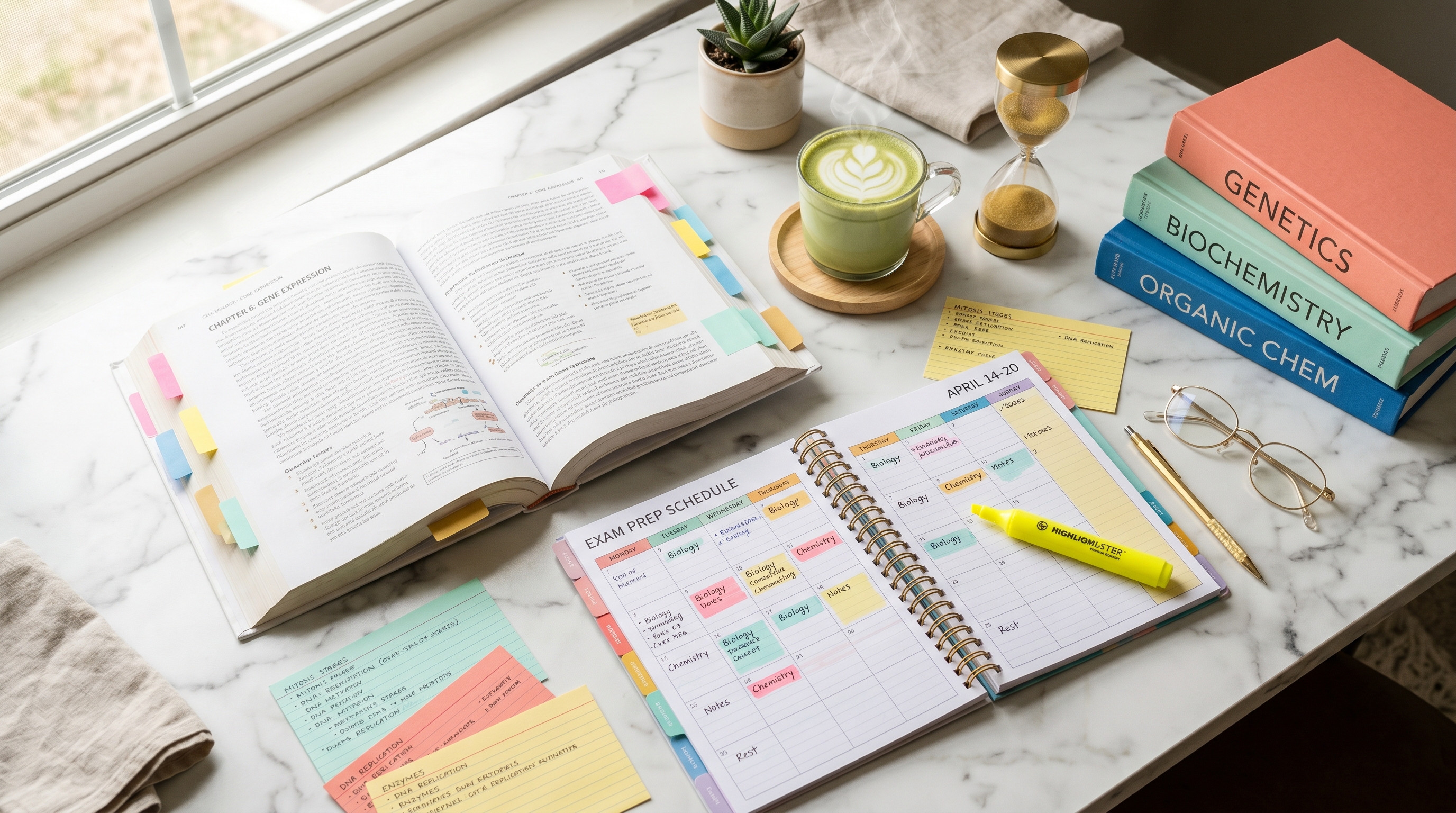
How to Prepare for Exams: The Ultimate Student Exam Preparation Guide
The word "exam" is usually enough to trigger an immediate spike in an average student's heart rate. Exams carry intense pressure, often accounting for 30% to 50% of your entire semester grade in a single two-hour window.
Most students prepare for this high-stakes event by locking themselves in the library the night before, chugging three energy drinks, and re-reading the textbook until their eyes burn. This is "cramming," and neurologically speaking, it is the absolute worst way to study.
If you want to walk into your next exam with unshakeable confidence, you need a systematic approach. Exam preparation is a multi-week process, not a multi-hour sprint. This is the ultimate, science-backed guide to exam preparation.
Two Weeks Before: The Triage Phase
Exam preparation does not start three days before the test. It starts 14 days out.
1. The Scope of the Mission
Before you read a single flashcard, you need to know exactly what is on the test.
- Gather Intelligence: Review the syllabus, past quizzes, and the professor's exam review sheet.
- The Brain Dump: On a blank piece of paper, write down every single major concept that will be tested.
- The Triage System: Next to each concept, code it with a color:
- Red: I have no idea how to do this. (Start studying this today).
- Yellow: I sort of know it, but I’d struggle to explain it.
- Green: I know this perfectly. (Do not waste time studying this yet).
Most students study their "Green" concepts first because it makes them feel smart and safe. You must attack the "Red" concepts first, when you still have the luxury of time to ask for help.
2. Backwards Planning
Calculate exactly how many study days you have. If the exam is on the 14th, and today is the 1st, you have 13 days. Break the material down into chunks and assign specific topics to specific days. Reserve the final two days before the exam strictly for full-scale practice tests and review, not for learning new material.
One Week Before: Active Recall Consolidation
By this point, you should understand the core concepts. Now, you need to transition into aggressive memory consolidation.
Understand vs. Memorize
You cannot memorize something you do not understand. If you don't understand how a cellular process works, memorizing the steps will be impossible. Use the Feynman Technique (explaining the concept in simple terms without looking at notes) to ensure true understanding.
Flashcard Sprints
Use tools like Anki or Quizlet to relentlessly drill vocabulary, dates, and formulas. Use the Pomodoro Technique (25 minutes on, 5 minutes off) to prevent mental fatigue while drilling.
Create the "Master Cheat Sheet"
Even if the exam is closed-book, pretend you are allowed a one-page cheat sheet. Force yourself to condense weeks of lectures into a single, highly dense, visually organized piece of paper. The cognitive act of deciding what is important enough to go on the cheat sheet is, ironically, the perfect study method.
Three Days Before: The Simulation Phase
Stop reading your textbook. Stop passively reviewing notes. It is time to practice output.
1. Practice Testing
The closest thing you can get to the real exam is a practice exam. Take it under absolute testing conditions.
- No music.
- No notes available.
- Set a strict timer. If your professor provides practice questions, these are gold. If not, look at the end-of-chapter questions in your textbook, or form a study group where each person writes 5 questions to test the others on.
2. The Post-Mortem
When you grade your practice test, don't just look at the score. Analyze every wrong answer mercilessly. Why did you get it wrong? Was it a silly math error? Did you misread the question? Did you completely forget a concept? Focus your remaining study hours only on the reasons you missed those questions.
The Day Before the Exam: The Taper
Athletes don't run a marathon the day before their marathon; they "taper" their training to rest their muscles. You must rest your brain.
- Morning: Do a light review of your "Master Cheat Sheet."
- Afternoon: Pack your bag. Ensure you have extra pencils, calculators (with fresh batteries), your student ID, and water.
- Evening: Stop studying by 7:00 PM. Eat a carbohydrate-heavy, comforting dinner.
- The Non-Negotiable: Sleep for at least 8 hours. Sleep is when your brain consolidates short-term memories into accessible long-term knowledge. Pulling an all-nighter actively sabotages your score.
Exam Day: Execution Strategy
You have prepared perfectly. Now you just have to execute.
- The Brain Dump (First 2 Minutes): As soon as the exam begins, flip the paper over. Write down every formula, date, or complex acronym you are terrified of forgetting while it is fresh in your mind. You now have a reference sheet.
- The First Pass: Go through the entire exam and answer only the questions you know immediately (the "Greens"). Skip anything that requires deep thought. This secures your base points and builds immense confidence.
- The Second Pass: Go back and tackle the medium-difficulty questions (the "Yellows"). You will be surprised at how your subconscious brain has worked on them while you were doing the easy questions.
- The Final Pass: Wrestle with the hardest questions. Never leave a multiple-choice question blank; at least eliminate the obvious wrong answers and guess.
Exam success is 80% preparation and 20% psychology. By following this multi-week guide, you strip away the anxiety of the unknown. You aren't guessing what will happen; you are executing a well-rehearsed plan. Good luck!