The Perfect Daily Study Routine for Students: A Productive Day Schedule That Works
"I'm going to study all day today."
You wake up on a Saturday, armed with good intentions. You sit at your desk at 10 AM. By 10:45, you are watching a YouTube video. By 1:00 PM, you feel guilty for not studying, so you stare blankly at a textbook while eating lunch. By 5:00 PM, you are exhausted, stressed, and have accomplished virtually nothing.
The ambition to "study all day" is fundamentally flawed. It lacks structure. A successful academic life isn't built on spontaneous bursts of chaotic all-day studying; it is built on a methodical, realistic, and predictable daily routine.
In this guide, we will break down the anatomy of a perfect, highly productive student day. This schedule is designed to maximize your cognitive peaks, ensure you actually get work done, and—most importantly—prevent burnout by scheduling mandatory rest.
The Anatomy of a High-Performance Student
Before we dive into the hour-by-hour schedule, we need to establish the three pillars of a productive routine:
- The Cognitive Load Rule: Your brain can only endure about 4 to 5 hours of deep, intense cognitive work per day. Don't try to schedule 9 hours of studying; it's biologically impossible to maintain focus for that long.
- Biological Rhythms: Most people experience a cortisol (alertness) peak in the mid-morning, an energy dip around 2 PM, and a secondary, slightly smaller peak in the late afternoon or early evening. We will structure the work to match these biological rhythms.
- The Buffer Zone: Every task takes 20% longer than you think it will. A perfect routine leaves empty space so that when things go long, your entire day doesn't collapse.
The Perfect Daily Schedule (Weekend or Reading Day Edition)
This schedule assumes you have the full day to control (like a weekend or a dedicated study day). If you have classes, you slot your classes into the "Deep Work" blocks.
Phase 1: The Launch (7:00 AM - 9:00 AM)
How you start the day dictates the momentum for the rest of it. The key here is low-friction, positive momentum.
- 7:00 AM - Wake Up & Hydrate: Do not touch your phone. Drink 20oz of water immediately. Your brain is dehydrated from sleep.
- 7:15 AM - Movement: Go for a 20-minute walk outside, do a quick yoga flow, or stretch. You need sunlight in your eyes to reset your circadian rhythm and halt melatonin production.
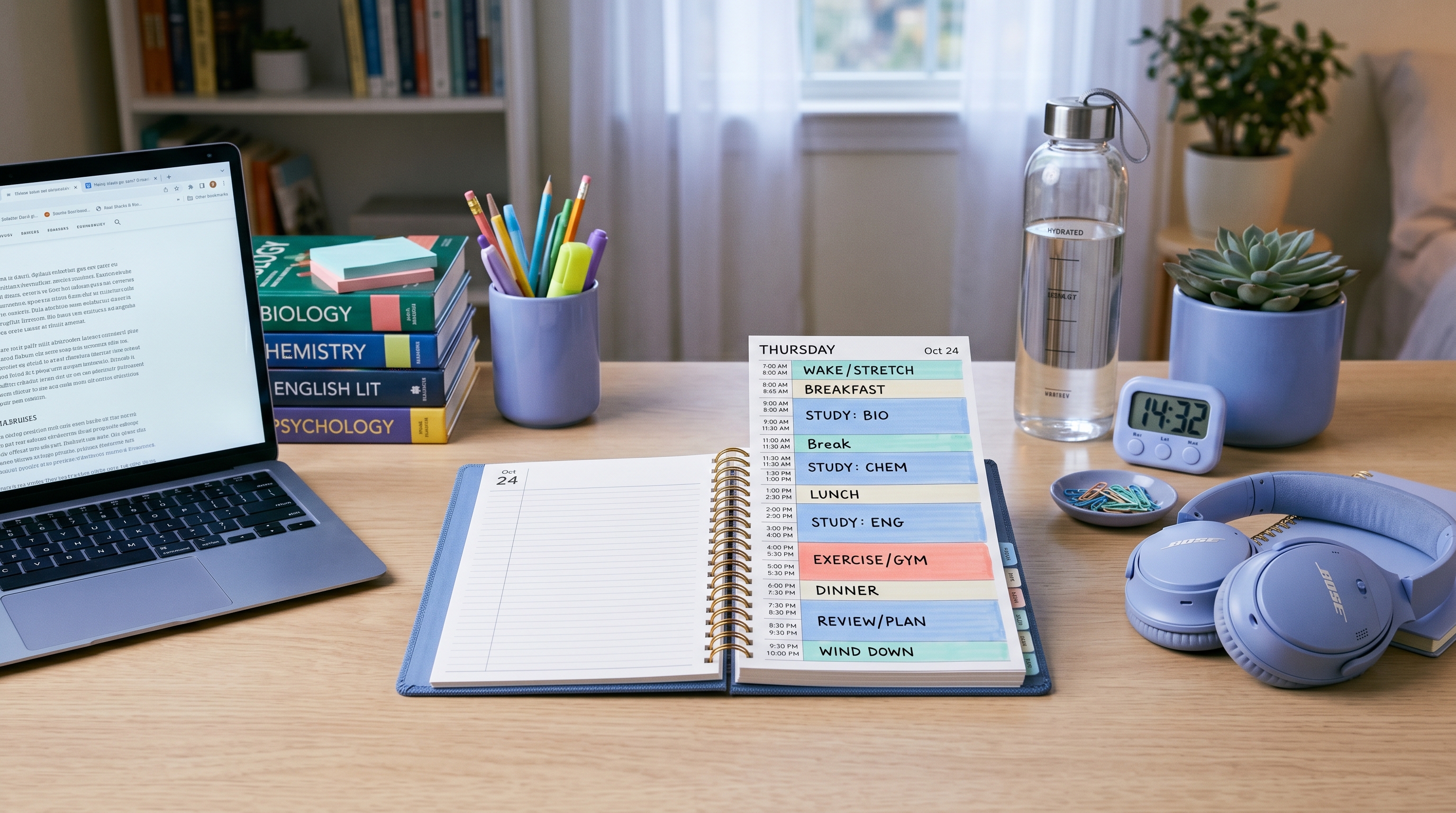
- 7:45 AM - Nourish & Plan: Eat a high-protein breakfast (protein prevents the mid-morning brain fog crash). Look at your planner. Identify your Three Most Important Tasks (MITs) for the day.
- 8:30 AM - The Aesthetic Setup: Clear your desk, light a candle, fill your water bottle, and open exactly the tabs you need.
Phase 2: The Deep Work Peak (9:00 AM - 12:30 PM)
This is your biological golden hour. Your brain is rested, alert, and capable of high-level synthesis, writing, and problem-solving. This is where you tackle your hardest task.
- 9:00 AM - 10:30 AM (Deep Work Block 1): Execute a 90-minute focus block on your absolute hardest assignment (e.g., writing an essay, learning new calculus concepts). Phone is in another room. No music with lyrics.
- 10:30 AM - 11:00 AM (The Real Break): Step away from the desk. Walk around, make tea, let your brain wander.
- 11:00 AM - 12:30 PM (Deep Work Block 2): Another 90-minute focus block. Handle your second major MIT.
By 12:30 PM, you have completed 3 solid hours of intense academic work. You have out-studied 90% of your peers before lunch.
Phase 3: The Afternoon Dip (12:30 PM - 3:00 PM)
Cortisol drops. Digestion requires energy. This is when students who try to "study all day" usually end up scrolling TikTok for two hours feeling guilty. Let's plan for the dip instead.
- 12:30 PM - 1:30 PM - Lunch & Disconnect: Eat a good lunch away from your desk. You are allowed to watch Netflix or YouTube here!
- 1:30 PM - 3:00 PM - Low Cognitive Load Tasks: Do not try to write an essay right now. Use this time for "admin" work:
- Replying to emails.
- Organizing your digital files.
- Highlighting printed articles.
- Creating flashcards (not memorizing them, just creating them).
Phase 4: The Second Wind (3:00 PM - 5:30 PM)
Your energy will naturally rebound in the late afternoon. This is the time for Active Recall and review.
- 3:00 PM - 5:00 PM (Review Block): This is where you run your Pomodoro sprints (25 minutes on, 5 off). Use Anki, do practice quizzes, or run through your Cornell notes. Because Active Recall is fast-paced, it keeps you awake even if you are feeling slightly tired.
- 5:00 PM - 5:30 PM (The Wrap-Up): Plan tomorrow. Write down what you accomplished. Close the textbooks.
Phase 5: The Sacred Evening (5:30 PM Onward)
If you followed this routine, you have accomplished roughly 5.5 hours of highly concentrated, effective study work. You are done. The evening is yours.
- 5:30 PM - 7:00 PM - Personal Time: Go to the gym, attend a club meeting, or hang out with friends.
- 7:00 PM - 8:00 PM - Dinner: Enjoy your meal without a textbook next to your plate.
- 8:00 PM - 10:00 PM - Pure Relaxation: Read fiction, watch movies, do skincare.
- 10:00 PM - 11:00 PM - Wind Down: Dim the lights, put the screens away, and prepare for 8 solid hours of sleep.
How to Adapt This to a Class Day
If you have lectures throughout the day, the skeleton of the routine remains the same, but the blocks shift:
- Treat classes as Deep Work Blocks.
- Use the 1-hour gaps between classes for the "Low Cognitive Load" administrative tasks.
- Use the evening (e.g., 6 PM - 9 PM) as your secondary deep work and review block.
Non-Negotiable Rules of the Routine
To make this schedule stick, you must ruthlessly enforce a few boundaries:
- The "Start Time" is sacred. If you say you start at 9:00 AM, you are sitting in the chair at 9:00 AM.
- The "End Time" is also sacred. If you plan to stop at 5:30 PM, you must stop at 5:30 PM. This forces Parkinson's Law (work expands to fill the time allotted). If you know you have literally all night to finish an essay, you will take all night to finish it. Enforcing a hard cutoff creates urgency.
- No guilt during breaks. If it is a scheduled break, enjoy it entirely.
Implementing this daily routine won't happen perfectly on day one. You will slip up. You will accidentally take a 2-hour lunch. That is fine. Treat the routine as a template to aim for, not a prison sentence.
When you consistently anchor your days with this structure, studying ceases to be an exhausting marathon of willpower. It simply becomes what you do between 9 AM and 5 PM.
Also read: Senior Year to College: Complete Graduation Guide 2026