Aesthetic Notes Ideas: The Complete Color Coding System That Makes Studying Actually Fun
Let's be completely honest: studying is infinitely more enjoyable when your notes look like a work of art.
There's a common misconception that "aesthetic notes" are just a waste of time—that spending five minutes writing a beautiful calligraphy header is procrastination disguised as productivity. But cognitive science says otherwise. When information is visually organized, color-coded, and aesthetically pleasing, your brain processes and retrieves it significantly faster.
Beautiful notes aren't just for Pinterest boards; they are highly functional maps of information. They make you want to open your notebook, reducing the initial friction of studying.
In this guide, we are breaking down exactly how to create beautiful, aesthetic notes, including the ultimate color-coding system and the best supplies to use.
Why Beautiful Notes Actually Help You Learn
Your brain is a highly visual engine. When you stare at a page of solid, messy black text, your eyes glaze over. It's an overwhelming wall of data without hierarchy.
Aesthetic note-taking solves this by introducing Visual Hierarchy. By using bold headers, indented bullet points, and specific color cues, you immediately signify to your brain what is a core concept, what is a supporting detail, and what is a vocabulary word. During an exam, you don't just remember the word; you remember that it was highlighted in pastel blue in the top right corner of your notebook. This is spatial and visual memory at work.
The Complete Color Coding System
The biggest mistake students make is highlighting everything in neon yellow. That defeats the entire purpose of highlighting. You need a structural color code.
Choose a single color family (e.g., Pastel Mint Green, Peach, and Lavender) and assign specific meanings to them for the entire semester.
The Standard Academic Color Code:
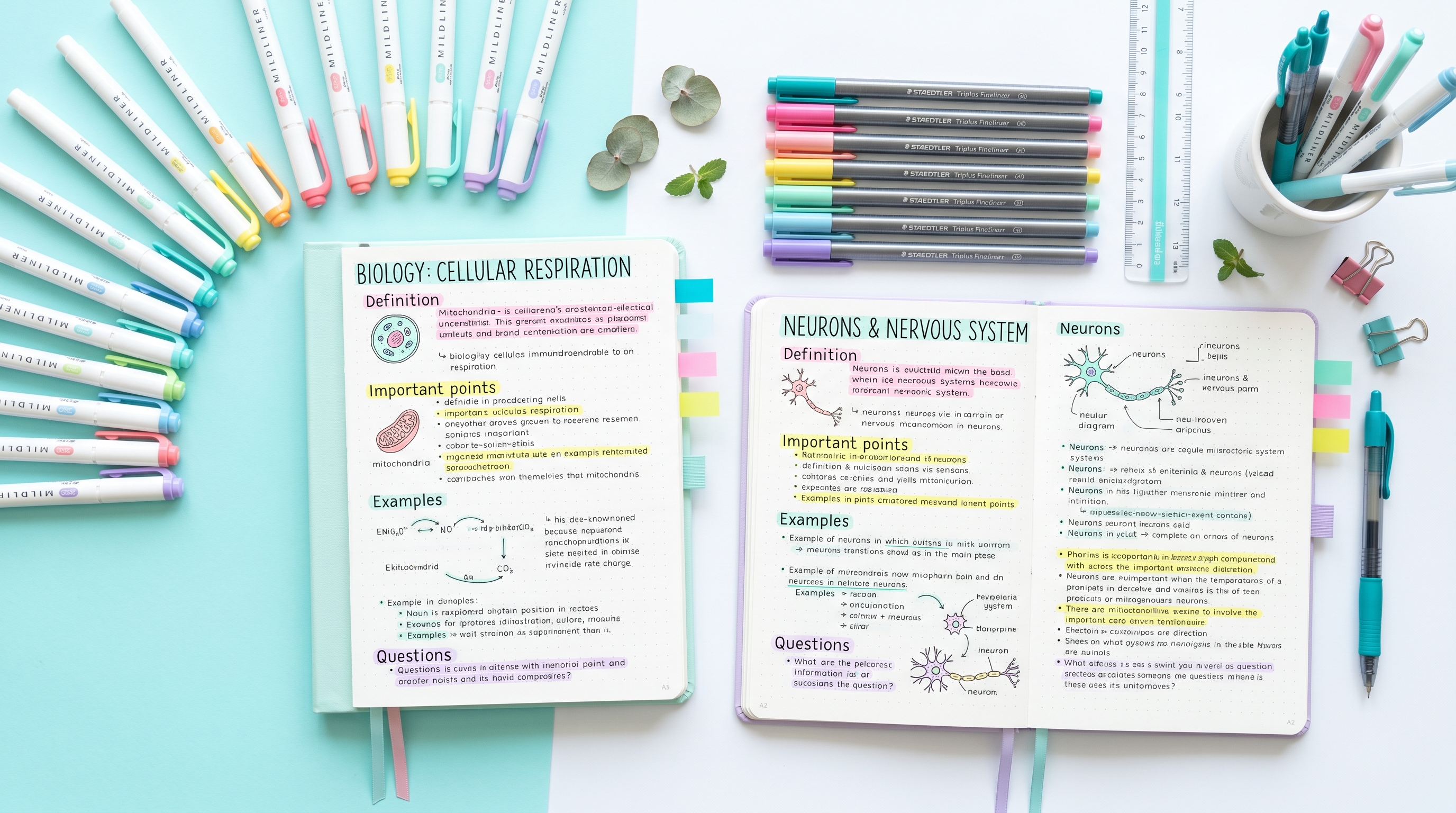
- Color 1 (e.g., Peach Focus): Headers & Main Topics. Use a colored marker to write the main chapter titles or large concepts.
- Color 2 (e.g., Mint Green Focus): Key Vocabulary & Definitions. Any time a new term is introduced, highlight the word in Mint Green. Write the definition in standard black ink next to it.
- Color 3 (e.g., Lavender Focus): Important Examples & Case Studies. When the professor gives a specific real-world example of the concept, mark it with Lavender.
- Red/Pink Pen: High Alert. Use a red or pink fine-liner to put stars next to things the professor explicitly says, "This will be on the test," or to mark concepts you personally struggle to understand.
- Black Pen: The standard body text for all explanatory sentences.
By sticking to this system, skimming your notes before a test takes seconds. If you need to memorize vocab, your eyes just scan the page for Mint Green.
Best Supplies for Aesthetic Notes
You don't need a hundred pens, but you do need the right ones.
- The Core Pen: Muji Gel Ink Pens (0.38mm or 0.5mm) in Black. They write incredibly smoothly and don't smudge under highlighters.
- The Highlighters: Zebra Mildliners. These are the holy grail of the study girl aesthetic. Their muted pastel and earth tones are easy on the eyes and don't bleed through the page.
- The Brush Pens: Tombow Dual Brush Pens. These are perfect for creating beautiful, sweeping faux-calligraphy headers.
- The Paper: Leuchtturm1917 Dotted Grid Notebooks. Dotted paper provides the structure of lined paper but looks infinitely cleaner and allows for easy drawing of charts and graphs.
The Aesthetic Cornell Notes System
The Cornell Notes system is classically rigorous, but we can make it aesthetic.
- Draw your vertical line 2 inches from the left margin. Use a Mildliner to draw the line instead of a black pen to soften the look.
- In the right column, take your standard notes using the Color Coding system mentioned above.
- In the left column, write your active recall questions. Use a bold, colored brush pen for these questions so they stand out.
- At the bottom, draw a soft pastel box with a highlighter and write a 2-sentence summary of the page inside the box.
Mind Mapping: The Aesthetic Style
Sometimes linear notes don't work, especially for subjects like History or Literature where concepts interconnect.
- Start in the absolute center of a blank, unlined page. Write the main topic in beautiful, large calligraphy. Draw a soft circle around it.
- Draw branches outward using different colored fine-liners.
- Each major branch should correspond to a sub-topic, and smaller twigs branching off those are the details.
- The result is a beautiful, sprawling web of knowledge that visually demonstrates how A relates to B.
Digital Note-Taking Aesthetic
If you are an iPad student, achieving the aesthetic is easier than ever.
- GoodNotes 6 or Notability: Download custom aesthetic notebook covers from Etsy or Pinterest.
- Custom Color Palettes: Go into the pen settings and input the exact HEX codes of your favorite pastel palette.
- Perfect Shapes: Use the "hold to snap" feature to ensure all your boxes, lines, and highlighting are perfectly straight.
- The Magic of Lasso: Written something slightly off-center? Just lasso it and move it. Your notes can be perfectly symmetrical every time.
Handwriting Improvement Tips
If you feel your handwriting ruins your aesthetic notes, practice these three things:
- Write with your arm, not your wrist. Keep your wrist locked and move the pen using your forearm. This provides smoother, less cramped letters.
- Slow down. The difference between messy scrawl and beautiful print is often just a 20% reduction in writing speed.
- Focus on uniform sizing. The single biggest factor in "neat" handwriting is ensuring all your short letters (a, c, e) hit the exact same invisible middle line, and all your tall letters (h, l, t) hit the exact same top line.
Transforming your notes takes a little extra effort at first, but once the color coding system becomes second nature, you'll be creating museum-worthy study guides without even thinking about it. Grab those Mildliners and get to work!